Let's name what's actually happening
Your body works fine alone. Solo, you orgasm reliably, sometimes intensely. Then your partner gets involved and suddenly your arousal flatlines. You're not broken. Your nervous system just switched modes the moment another person entered the room.
This is not rare. This is not a personal failure. This is your parasympathetic nervous system doing its job too well.
The neuroscience of being watched
When you're alone, your brain is in rest-and-digest mode. Blood flows freely to your genitals. Your pelvic floor stays relaxed. Arousal builds in a linear way. Then your partner shows up, and suddenly your sympathetic nervous system activates. You're not being chased by a tiger, but your lizard brain doesn't know that.
This activation isn't about attraction or desire. It's about safety. Your amygdala registers another person as a stimulus that needs monitoring. Part of your cognitive bandwidth gets allocated to "what is this person thinking about me right now." Another part worries about performance. A third part catalogues any sound they're making.
That's three separate neural threads running in parallel, none of them focused on the sensations between your legs.
The research backs this up. Studies on orgasm difficulty in partnered contexts show that the issue is almost never physical. It's attention. When your nervous system is split between pleasure and monitoring, pleasure loses.
Why a lemon vibrator changes the equation
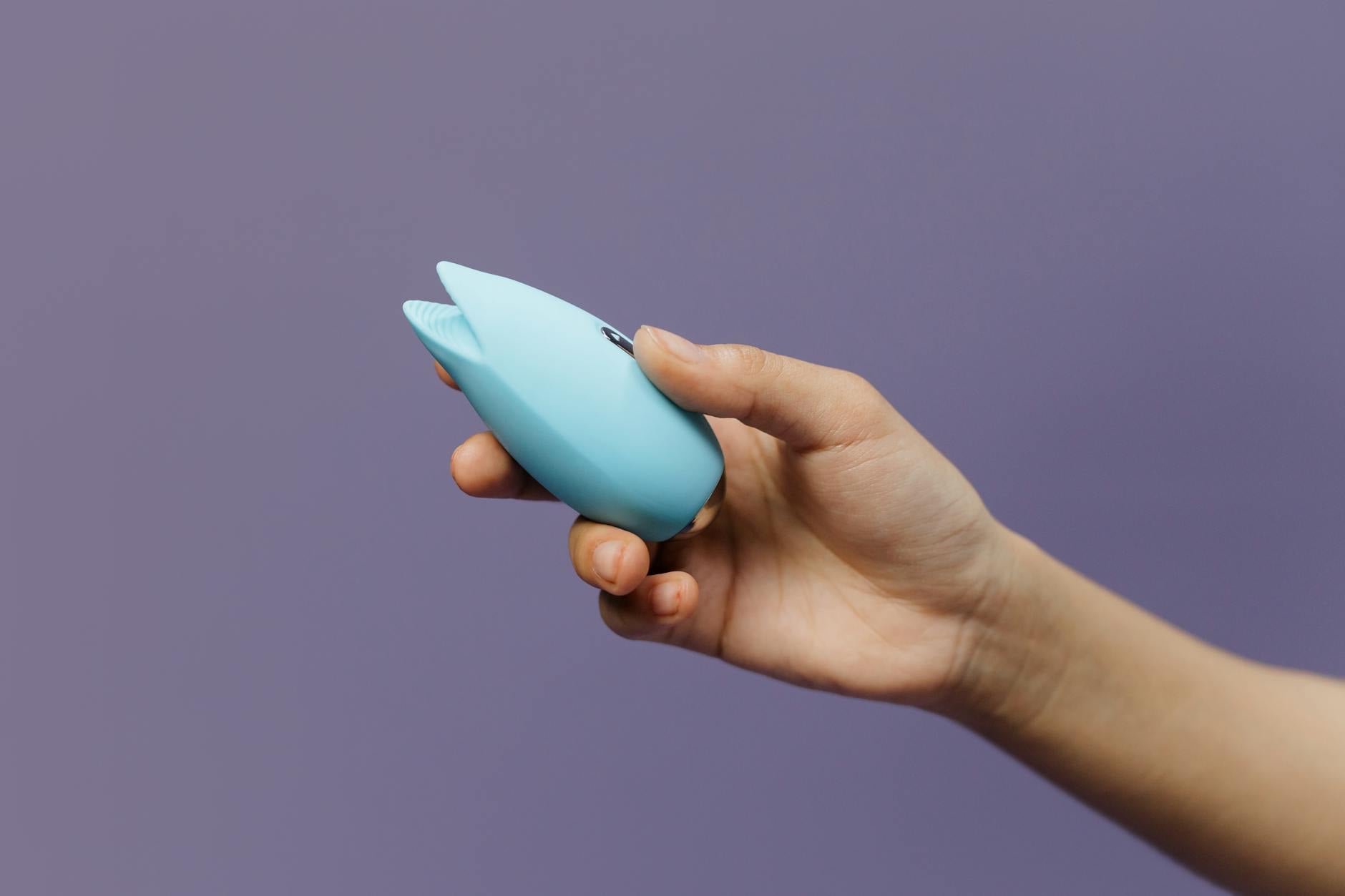
A lemon clitoral vibrator does something simple but neurologically powerful. It anchors your attention.
Most people think vibrators work by providing more stimulation. They do. But the deeper mechanism is that a vibrator gives your brain a single, overwhelming sensory channel to attend to. The suction pattern, the intensity, the rhythm. Your amygdala registers "threat level: handled" because you have a concrete tool. Your partner's presence becomes background noise instead of a primary threat assessment.
A lemon sucker specifically works because the sensation is so distinct from penetrative touch. If your partner is inside you, a lemon vibrator on your clitoris creates a sensory contrast that actually improves communication between your body and brain. You're not waiting for stimulation to arrive via another person's body. You're creating it independently.
This matters psychologically too. The moment you introduce your own toy, you're saying, "I'm in charge of my own pleasure here." That statement shifts power dynamics in a way that's neurologically calming.
The practical setup that works
Start with communication, not the toy itself. Tell your partner: "I want to reach orgasm with you, and my body needs this tool to do that. It's not about you. It's about how my nervous system is wired." Most partners hear this as relief, not rejection. You're solving a problem they've been aware of too.
Use the vibrator before they're even in the picture. If you're having difficulty orgasming with your partner present, your first job is to prove to yourself that the lemon vibrator works in that context at all. Spend two or three solo sessions at intensity level 3 or 4, learning which pattern on the Hello Nancy Lem gets you closest to climax. Don't aim for orgasm in these sessions. Just aim for arousal building to 7 or 8 on a 10-point scale.
Then introduce your partner gradually. Start with them in the room but not touching you. You're using the vibrator on yourself while they're reading or present but not engaged. The goal here is desensitization. Your nervous system learns: "partner present does not equal performance demand."
Next, add touch. Your partner can touch your breasts, your inner thighs, your neck. Not your genitals where the vibrator is. This layer of intimacy without genital performance pressure is the sweet spot. Most people find that once they reach this point, the nervous system settles enough that orgasm becomes possible.
What actually happens when it works
When you do orgasm in this context, something shifts. Your brain begins to associate your partner's presence with pleasure instead of with threat. Over time, you may find that you need the vibrator less often. Not always. Some people always want the vibrator in partnered sex, and that's completely fine. But the neurological association changes.
I've seen couples who spent five years unable to reach orgasm together suddenly orgasm within weeks once they introduced a lemon clitoral vibrator and got clear about the communication. The vibrator isn't a crutch. It's a bridge. It teaches your nervous system that partnered sex can be safe and pleasurable at the same time.
The intensity conversation
Here's where most people get stuck. Your partner might worry that if you need a vibrator at level 5, you're desensitized. You're not. Clitoral tissue has more nerve endings than penises. You can use high-intensity stimulation regularly without reducing sensitivity. If anything, regular clitoral stimulation improves sensitivity over time.
But if you're nervous about your partner's reaction, reframe it. The Lem vibrator isn't stronger than a partner's touch in some absolute sense. It's just focused. A laser pointer isn't "stronger" than sunlight. It's concentrated. Your clitoris responds to concentration.
The timing that helps
Don't wait until you're already aroused to introduce the vibrator. That's backwards. Introduce it early, as part of foreplay. Start at level 2 or 3 while your partner is kissing you or touching you elsewhere. Let arousal build first, then increase the intensity. This prevents that "wait, we're using this now?" moment that can snap you back into performance mode.
Also, give yourself a reality check about timing. If you usually take 20 minutes to orgasm alone, you're not going to orgasm in 5 minutes with a partner watching, even with a vibrator. Budget time. Tell your partner: "I need about 15 or 20 minutes once we start using the vibrator." This removes the anxiety of "are we taking too long."
When to adjust your approach
If you're using a lemon vibrator at level 5 and still not orgasming with your partner, something else is at play. It might be relationship anxiety, not just nervous system activation. This is worth exploring with a therapist or coach. A vibrator solves a sensory problem. It doesn't solve relationship trust issues.
Also check: is your partner actually present and engaged, or are they on their phone? Even subtle inattention can activate your threat detection. You need them focused on you or on their own pleasure, not bifurcated.
The long game
Some people use a lemon vibrator every single time they have partnered sex. Some use it occasionally. Some use it until they've rewired their nervous system, then set it aside. All three paths are normal and fine. The point isn't to become dependent on the toy. The point is to reclaim the ability to orgasm with your partner while staying sane and present.
Once you've proven to yourself that partnered orgasm is possible, your body starts believing it. That belief is where the real change happens.